African Spurred Tortoise
Centrochelys sulcata
Family: Testudinidae | Genus: Centrochelys
Terrestrial | Herbivore | Dry savannahs and arid regions | Up to 85 cm | Up to 100 kg | Up to 75-100 years
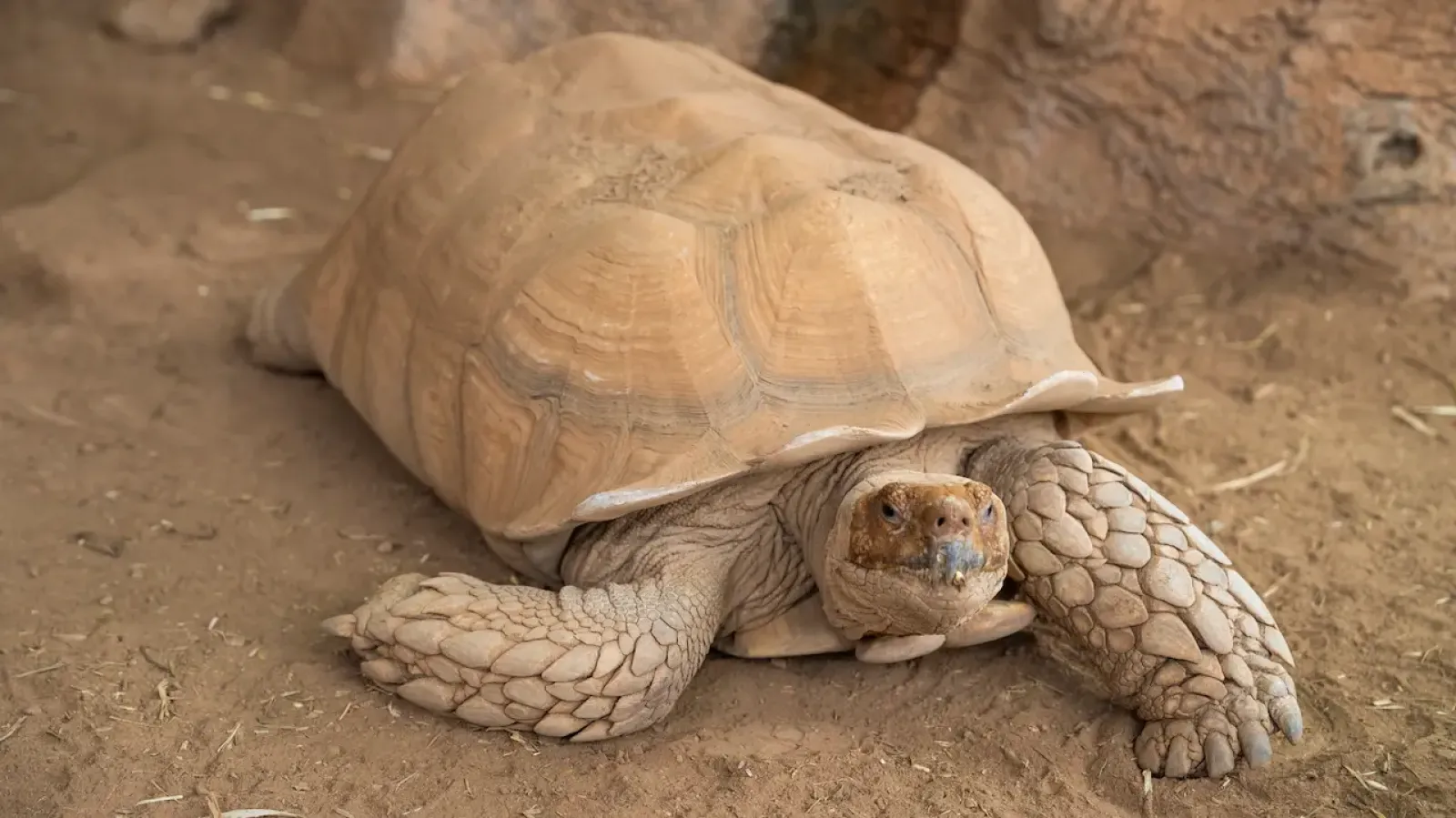
The African spurred tortoise (Centrochelys sulcata) is the third-largest tortoise species in the world and the largest mainland tortoise. While giant tortoises are typically associated with islands, where theabsence of large predators has favoured the evolution of exceptional body size, this remarkable specieshas reached impressive dimensions on the African continent.
Its common name comes from the prominent spurs found on its hind legs. When threatened, the tortoise retracts into its shell, leaving these pointed structures exposed as an additional defensive feature.
African spurred tortoises have evolved remarkable adaptations that allow them to thrive in the harsh environments of the Sahel. They dig deep burrows, reaching depths of up to three metres, which provide shelter from extreme heat. They are also surprisingly powerful, capable of lifting the front of their bodies and forcefully pushing against obstacles.
Strictly herbivorous, they feed mainly on fibrous vegetation rich in calcium. Through both their feeding habits and their extensive burrowing activity, they act as ecosystem engineers, contributing to the ecological balance of the Sahel.
Geographical Distribution
Found across sub-Saharan Africa in the Sahel region, including Ethiopia, Sudan, South Sudan, Chad, Niger, Mali, southern Mauritania, Senegal, the Central African Republic and Cameroon.
Habitat
It inhabits arid environments such as dry savannahs with sandy soils, where it can dig deep burrows for shelter from extreme temperatures and for nesting.
Habitat description: It prefers ecosystems characterised by:
- Dry, arid savannahs with scattered vegetation and low rainfall.
- Sandy and semi-arid soils suitable for burrowing.
- Warm climates.
- Grasslands with fibrous grasses that provide an abundant food source.
Lifestyle and Behaviour
African spurred tortoises are solitary, terrestrial reptiles perfectly adapted to life in extremely arid environments. They excavate extensive underground burrows that provide refuge during the hottest hours of the day. These tunnels may reach depths of up to three metres and lengths of up to ten metres, creating cooler and more humid microclimates. As ectothermic animals, they rely on warm temperatures to remain healthy, while prolonged exposure to cold conditions can lead to serious respiratory illnesses.
Social Behaviour
- Predominantly solitary.
- Males become highly aggressive towards one another during the breeding season.
- They use force and violent charges to establish dominance.
- No parental care is provided after hatching.
Daily Activity
- Most active during the coolest parts of the day, at dawn and dusk.
- Shelter inside deep burrows during the intense midday heat.
- They do not hibernate because of their tropical habitat.
- Slowly graze on grasses and other fibrous plants.
- Surprisingly strong and agile, capable of lifting the front of the body and forcefully pushing obstacles aside.
Reproduction
- Oviparous species, mating between September and November.
- Males may travel distances of up to 100 kilometres in search of females.
- Females dig nesting burrows where they lay between 15 and 30 eggs per clutch.
- Incubation lasts up to 200 days (approximately six to seven months).
- No parental care after egg laying: the female digs the nest, lays the eggs, covers them and leaves.
- Hatchlings are fully independent from birth.
Relationship with their Environment
- Ecosystem engineers: Their extensive burrows provide shelter not only for themselves but also for many other animal species.
- Thermoregulation: Burrows help maintain optimal body temperature, allowing them to cope with the extreme conditions of the Sahel.
- Defensive spurs: Pointed projections on the hind legs remain exposed when the tortoise withdraws into its shell.
- Exceptional strength: Capable of moving heavy obstacles and delivering powerful charges.
Diet
In the wild
- Strictly herbivorous.
- Feeds mainly on fibrous plants and grasses found in the savannah.
- Diet rich in fibre and calcium, essential for healthy shell development.
- Consumes grasses, flowers, dried leaves and succulent plants.
- Occasionally ingests soil to obtain minerals.
- Requires large quantities of food due to their considerable size.
Under human care
- Fed daily according to the size and age of each individual.
- Diet based on fresh vegetables and hay, primarily leafy greens such as kale and lettuce, supplemented with carrots, red peppers and other vegetables.
- Hydration is mainly provided through fresh vegetables. Fruits with a high water content may occasionally be offered, particularly during periods of extreme heat.
Conservation Status
The African spurred tortoise (Centrochelys sulcata) is classified as Endangered (EN) on the Red List of the International Union for Conservation of Nature.
Main threats:
- Urbanisation and infrastructure development, resulting in habitat loss across the Sahel.
- Illegal capture for exotic pet trade.
- Desertification caused by climate change and overgrazing.
- Human-wildlife conflict, as the species is considered an agricultural pest in some areas.
- Egg collection for human consumption.
- Habitat loss due to agricultural expansion.