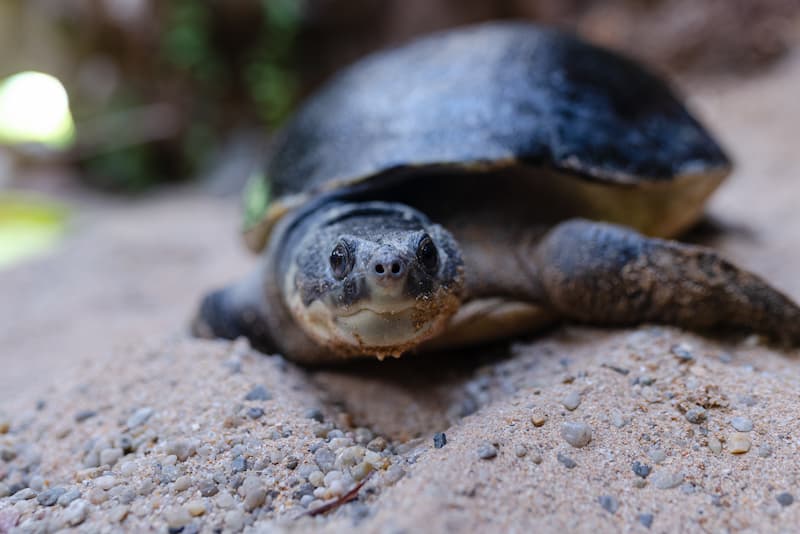
Pink-bellied Snapping Turtle
Elseya branderhorsti
Family: Chelodidae | Genus: Elseya
Freshwater | Carnivorous | Rivers and swamps | Papua New Guinea | Up to 50 cm
The Pink-bellied Snapping Turtle (Elseya branderhorsti), also known as the Branderhorst Snapping Turtle, is a freshwater turtle endemic to Papua New Guinea. Its English name refers to the pinkish or reddish colouration of its plastron. Another distinctive feature is its eyes, which have a soft, indistinct outline that is often described as giving the species a “liquid-eyed” appearance.
Geographic distribution
This species is endemic to Papua New Guinea, meaning that it is found nowhere else in the wild. Its distribution is restricted to the island’s river systems and wetlands, whereit depends on freshwater habitats rich in vegetation, particularly areas of slow-moving water.
Habitat
It lives exclusively in freshwater habitats.
Characteristics of its habitat:
-
Inhabits rivers with moderate currents
-
Also found in freshwater swamps
- Prefers areas with dense aquatic vegetation
- Frequently found on muddy substrates
Lifestyle and behaviour
The Pink-bellied Snapping Turtle leads a largely sedentary, aquatic lifestyle. It spends much of its time concealed in the water, patiently waiting for prey.
Social behaviour
- It is predominantly solitary
- Individuals typically interact only during the breeding season
- Outside the breeding season, it tends to be intolerant of other individuals of its species
Daily activity
- It is mainly active during the day, although it may also be active at twilight
- It explores different parts of its habitat while searching for food
- It spends much of its time lying motionless, waiting for the chance to snap up prey
- Occasionally, it leaves the water to bask in the sun and regulate its body temperature
Reproduction
- It is oviparous, meaning it reproduces by laying eggs
- The female lays her eggs in sandbanks or muddy soil close to the water
- Each clutch contains between 4 and 12 eggs
- The incubation period is thought to last between 2 and 3 months
- The female provides no parental care after laying her eggs
Relationship with its environment
- As an aquatic predator, it plays an important role in river and swamp ecosystems
- It helps regulate populations of smaller fish and invertebrates within its habitat
- As an endemic species, it is entirely dependent on the preservation of Papua New Guinea’s river systems and wetlands
- Its presence can serve as an important indicator of the ecological health of its habitat
Diet
In its natural habitat
- It is a carnivorous species
- Its diet consists mainly of small and medium-sized fish
- It also feeds on invertebrates such as shrimp, crabs, and insects
- It hunts primarily by ambush
Under human care
-
Its varied diet includes trout, roach, smelt and chicken
-
It is fed approximately twice a week
Conservation status
The Pink-bellied Snapping Turtle (Elseya branderhorsti) is classified as Vulnerable (VU) on the International Union for Conservation of Nature (IUCN) Red List.
Its main threats include:
-
Habitat loss due to deforestation along riverbanks and in swamp areas
-
Predation of its eggs by invasive species
-
Alterations to river courses that degrade its habitat