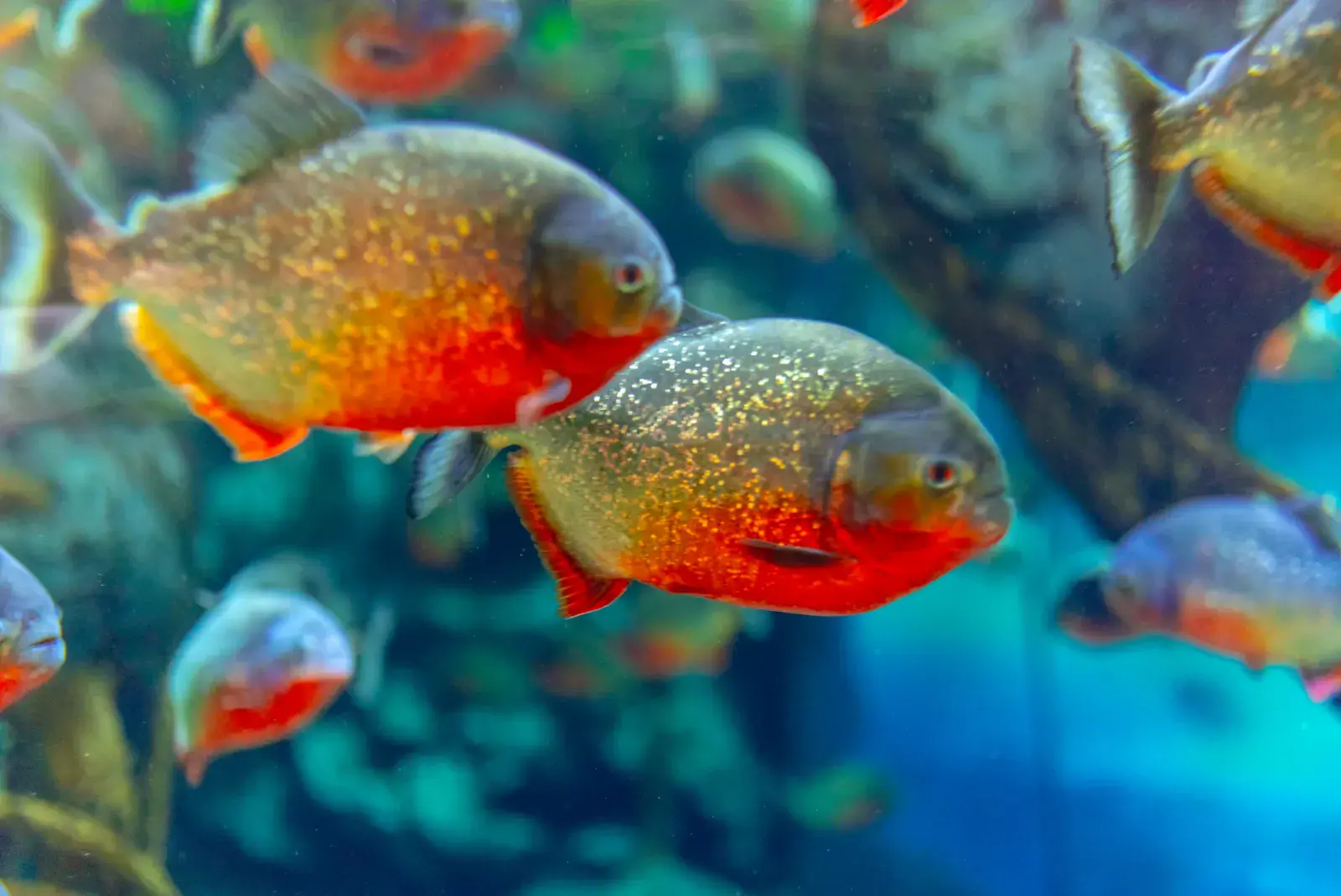
Red-bellied piranha
Pygocentrus nattereri
Familia: Serrasalmidae | Género: Pygocentrus
Freshwater rivers and river basins | Carnivore | South America | up to 33 cm | up to 10-15 years
The red-bellied piranha is one of the most iconic and widely recognised fish inhabiting South American rivers. Although it is not the Amazon's largest predator, its speed and efficiency when hunting in schools make it a highly effective hunter. This carnivorous species also displays scavenging behaviour, feeding on weak or dying animals, which gives it an important ecological role by recycling organic matter within freshwater ecosystems. It is distinguished by its powerful jaws, razor-sharp teeth and highly social nature.
Geographical distribution
Found throughout South America, including the Amazon River basin, the Paraguay–Paraná River basin, the coastal rivers of north-eastern Brazil and the Essequibo River basin. It has also been recorded in Brazil's Uruguay River.
Habitat
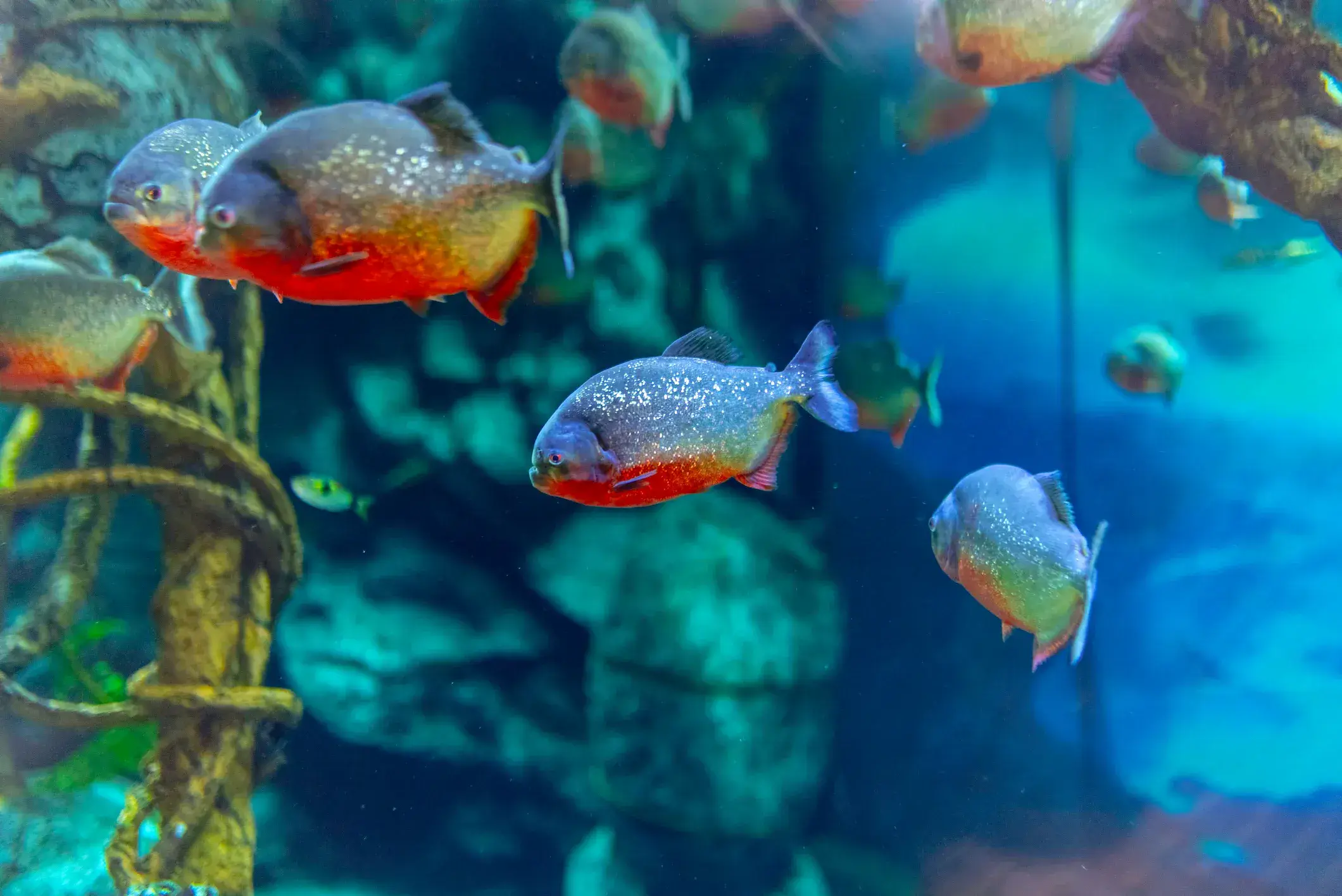
It inhabits river basins and coastal rivers, typically occupying mid-water levels or areas close to the surface.
Habitat description: It prefers ecosystems characterised by:
• Tropical river basins with warm freshwater.
• Mid-water areas in rivers with moderate currents.
• Surface waters suitable for coordinated group hunting.
• Coastal rivers with abundant riverside vegetation.
• Areas with submerged tree roots used for egg deposition.
Lifestyle and behaviour
Red-bellied piranhas are highly social fish that live and hunt in schools, using coordinated hunting strategies. Their predatory behaviour is methodical: one individual delivers an initial bite to assess the prey's ability to defend itself. If little or no resistance is detected, the rest of the school quickly joins in. They also possess highly developed senses that allow them to detect prey from a distance and communicate effectively with one another.
Social behaviour:
• Live in large schools.
• Hunt cooperatively in coordinated groups.
• One individual first assesses the prey's vulnerability.
• Gregarious behaviour at mid-water depths or near the surface.
Daily activity:
• Swim in groups at mid-water depths or close to the surface.
• Active, coordinated hunting in schools.
• Detect prey using their sense of smell and lateral line.
• Hunting strategy based on individual assessment followed by a group attack.
Reproduction:
• Lay their eggs among the roots of submerged trees.
• Eggs are guarded by both parents.
• Eggs hatch after 9–10 days.
• Seasonal breeding during periods of high water.
Relationship with their environmente:
• Sense of smell: Highly developed, enabling them to detect traces of blood in the water from several kilometres away.
• Acoustic communication: They produce sounds using muscles attached to the swim bladder. These sounds are detected by sensory cells along the lateral line and are primarily used in threatening situations. They are also easily audible to humans.
• Ecological role: Recycle organic matter by feeding on vulnerable or dying animals.
• Predatory strategy: Based on coordinated hunting in schools, beginning with an individual assessment before the group attack.
Diet
In the wild
• Carnivorous species with scavenging tendencies.
• Feeds mainly on fish, as well as insects and worms.
• Consumes vulnerable or dying animals, contributing to the recycling of organic matter.
Under human care:
• Varied diet consisting mainly of fish, prawns and other protein-rich foods.
• May also accept frozen food and specially formulated pellets.
Conservation status
The red-bellied piranha is classified as Least Concern (LC) on the International Union for Conservation of Nature Red List.
Main threats:
• Alteration of river habitats through dam construction.
• Pollution affecting rivers and freshwater basins.
• Deforestation of riverside habitats.