Home
Home Plan your visit
  Jungle
  Tropical
  School Visits
 Encyclopedia
 Blog
Blog


Green and black poison dart frog
Dendrobates auratus
Family: Dendrobatidae | Genus: Dendrobates

Terrestrial | Carnivorous | Tropical rainforest | Central America and Colombia | Up to 4.2 cm | Up to 8 years
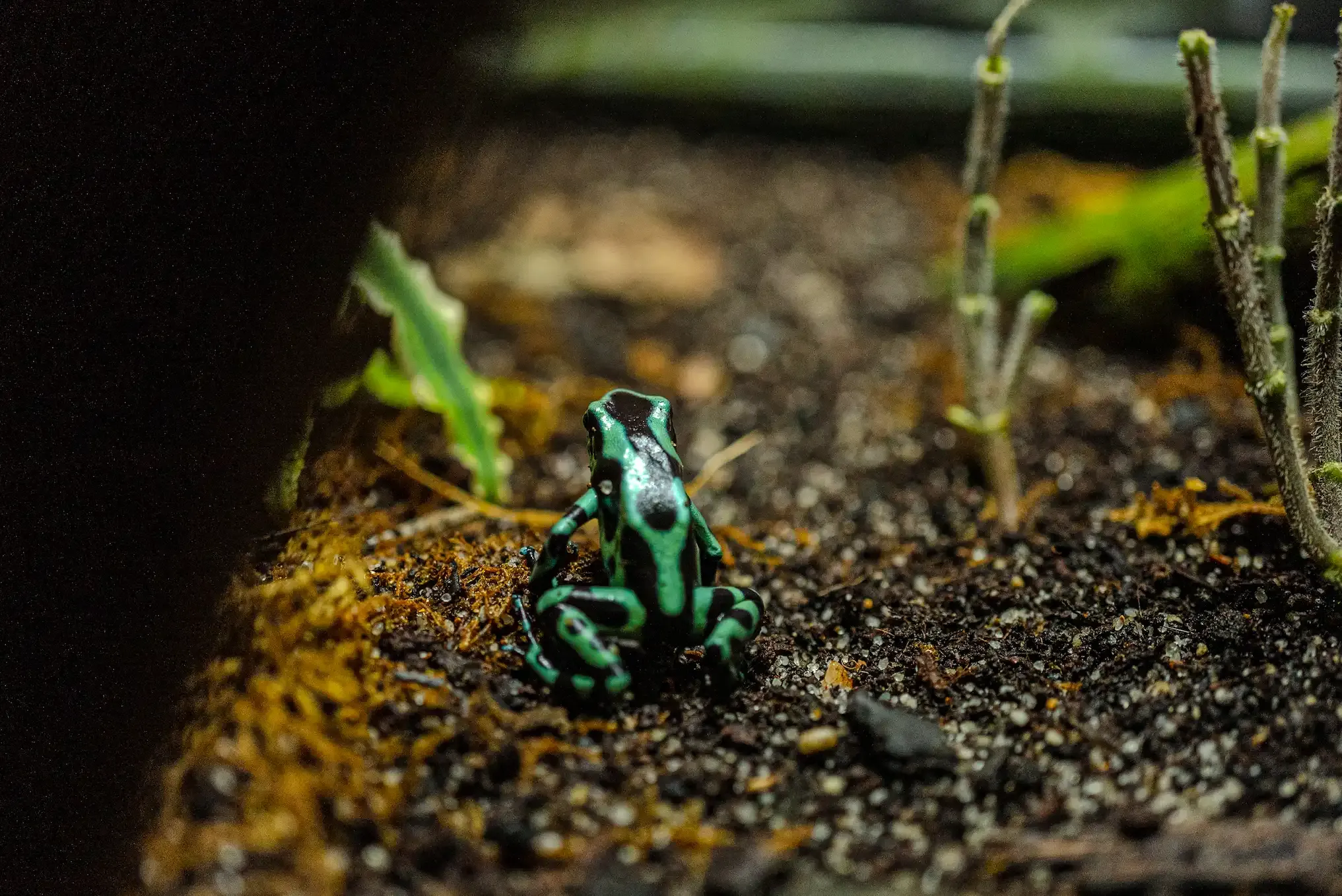
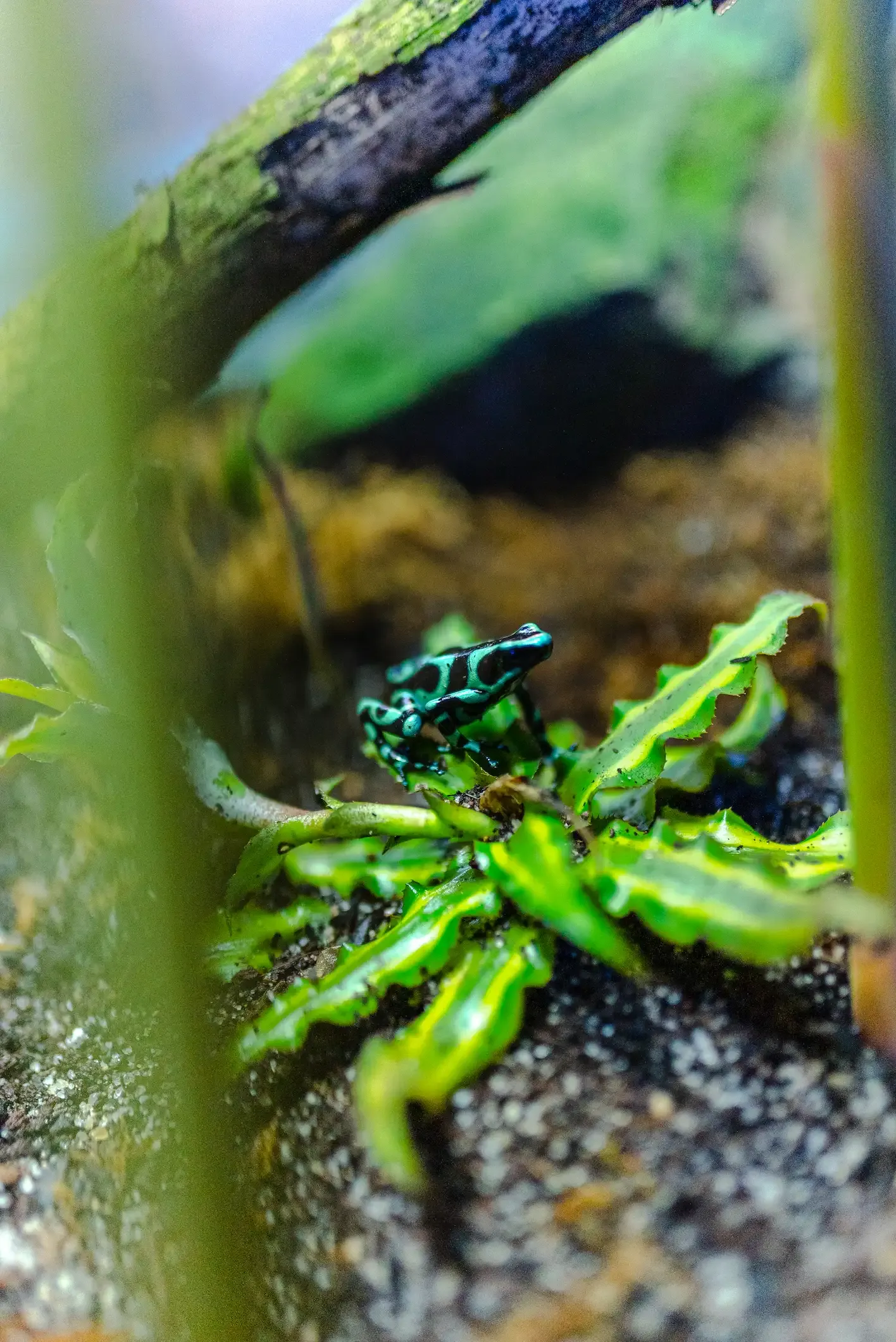
The green and black poison dart frog (Dendrobates auratus) is a small amphibian known for its striking coloration, which serves an aposematic function, warning predators of its toxicity. However, its common name can be misleading, as not all populations display only green and black tones; some individuals also show bluish, yellowish or even whitish colouration, always combined with dark markings. Although this is a highly toxic species, it does not produce its toxins itself. Instead, it obtains them through its diet, which consists mainly of ants containing toxic compounds.
For such a small species, it displays remarkably complex social and reproductive behaviour. It is also an excellent climber, capable of reaching heights of up to 45 metres in rainforest trees.
GEOGRAPHICAL DISTRIBUTION
It is found in Central America. Along the Caribbean coast, its range extends from southern Nicaragua to the Gulf of Urabá, between Panama and Colombia. Along the Pacific coast, it occurs from southern Costa Rica to the northern Pacific coast of Colombia.
It is also found on Oahu, Hawaii, where it was introduced as an exotic species for mosquito pest control.

HABITAT
LIFESTYLE AND BEHAVIOUR
DIET
IN THE WILD
- It is a carnivorous animal specialised in feeding on insects.
- It feeds on a variety of insect larvae.
- It consumes ants, from which it obtains its defensive toxins.
- It also feeds on termites, small beetles, flies, dipterans and other small arthropods.
- It actively captures its prey while foraging.
UNDER HUMAN CARE
- Its diet is based mainly on fruit flies.
- It also receives small crickets, woodlice and springtails.
- It is fed twice a day.
 CONSERVATION STATUS

The green and black poison dart frog (Dendrobates auratus) is classified as Least Concern (LC) according to the International Union for Conservation of Nature (IUCN) Red List.
Its main threats are:
• Deforestation of tropical rainforest for agricultural purposes.
• Habitat fragmentation.
• Loss of biodiversity, particularly among its prey.
• The use of pesticides.
• Changes in rainfall patterns, which alter its reproductive cycles.
RELATED SPECIES AT POEMA DEL MAR
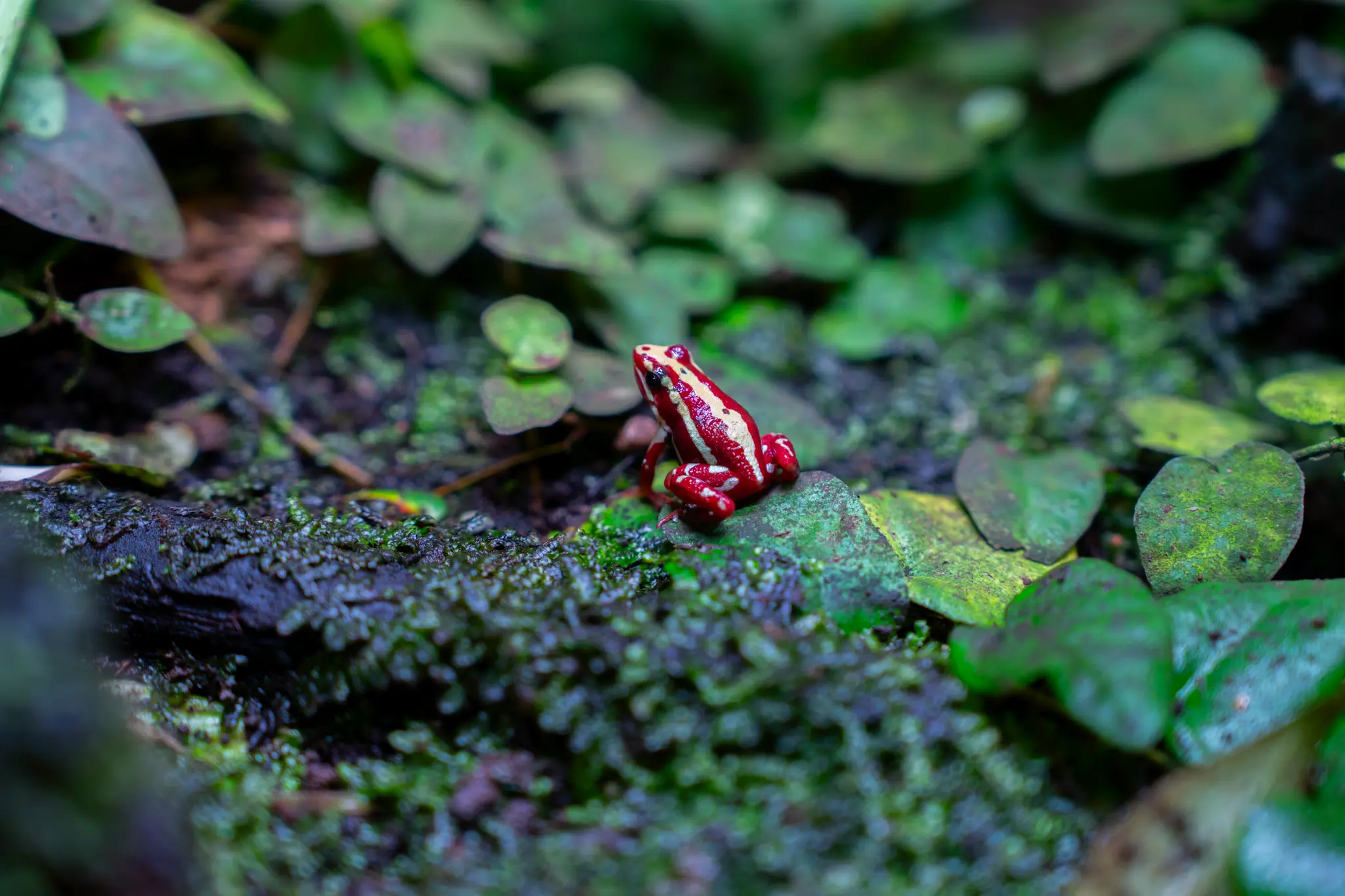
Tricolour poison frog