Common Seadragon
Phyllopteryx taeniolatus
Family: Syngnathidae | Genus: Phyllopteryx
Coastal waters | Carnivore | Seagrass meadows | Southern and south-eastern Australia | Up to 45 cm
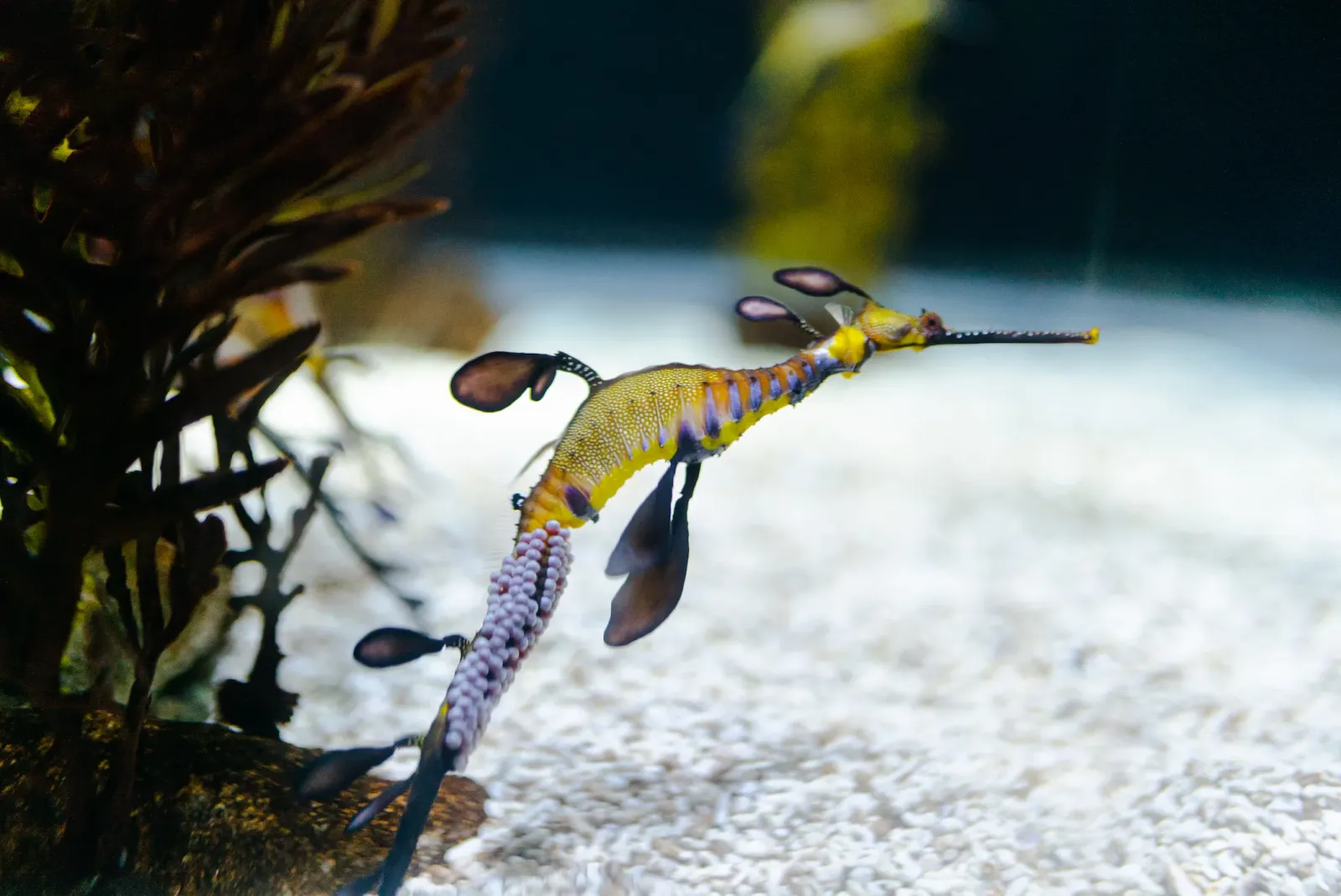
The common seadragon (Phyllopteryx taeniolatus) is one of the ocean's most remarkable fish species. A close relative of the seahorses, it has an elongated body adorned with distinctive leaf-like appendages that closely resemble drifting seaweed. This extraordinary camouflage allows it to blend seamlessly into its surroundings, making it extremely difficult for predators to distinguish it from the surrounding marine vegetation.
In addition to its exceptional camouflage, the common seadragon is known for its longevity. Individuals living in warmer waters typically survive for six to seven years, while those inhabiting the cooler waters of southern Australia can live for up to ten years.
Geographical distribution
The common seadragon is endemic to the coastal waters of southern and south-eastern Australia.
Habitat
The common seadragon inhabits coastal environments where dense marine vegetation provides essential camouflage. It occupies a variety of habitats, ranging from rocky reefs covered with kelp and other macroalgae to adjacent sandy seabeds. It is found from shallow coastal waters to depths of approximately 50 metres.
It prefers ecosystems characterised by:
- Kelp forests and seagrass meadows.
- Rocky reefs and nearby sandy seabeds.
- Temperate coastal waters of southern Australia.
Lifestyle and behaviour
The common seadragon swims using two small fins that move with subtle, wave-like motions, producing its distinctive graceful swimming style. In addition, it is a slow and discreet swimmer, an adaptation that further enhances its camouflage.
Social behaviour:
-
Generally solitary.
-
During the breeding season, males may gather in small groups, sometimes referred to as "nurseries", while carrying eggs.
Daily activity:
-
Moves slowly among marine vegetation.
-
Spends much of its time feeding and remaining concealed among seaweed.
Reproduction:
-
Courtship involves an elaborate mating dance, after which the female transfers her eggs to the underside of the male's tail.
-
The male incubates the attached eggs for approximately 50 to 60 days, after which young measuring around 1 cm hatch.
-
Each clutch may contain up to 120 eggs, measuring approximately 3–4 mm in diameter and 5–6 mm in length. The eggs remain firmly attached to the ventral surface of the male's tail until hatching.
-
In 2020, Poema del Mar became the first aquarium in Europe to successfully breed the common seadragon. This achievement was made possible through the design of a specialised habitat that carefully replicated the species' natural environmental conditions, including light levels, temperature and water depth.
Relationship with their environment:
-
Their remarkable camouflage provides effective protection from predators.
-
They depend on healthy seagrass meadows and kelp habitats for survival.
Diet
In the wild
-
Feed mainly on zooplankton, small crustaceans and molluscs, which they suck into their tubular mouth.
Under human care
-
Their diet consists primarily of live or frozen mysid shrimp (Mysis).
-
Small planktonic crustaceans and fish larvae also form part of their diet.
Conservation status
The common seadragon (Phyllopteryx taeniolatus) is classified as Vulnerable (VU) on the International Union for Conservation of Nature Red List.
Main threats:
-
Degradation and loss of seagrass and kelp habitats.
-
Marine pollution and changes to coastal ecosystems.
-
Human activities and increasing pressure on coastal environments.