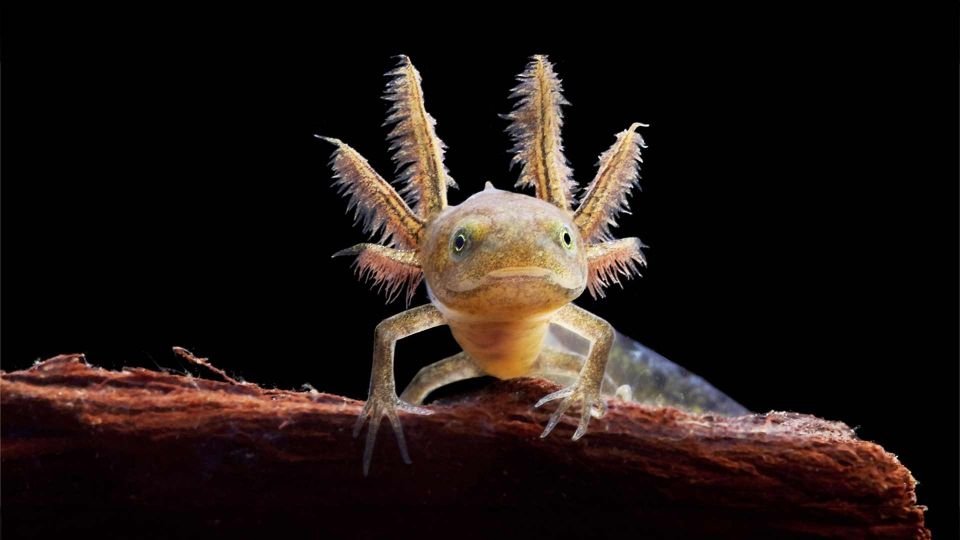
Sword-tailed Newt
Cynops ensicauda
Familia: Salamandridae | Género: Cynops
Freshwater | Carnivorous | Partially terrestrial | Ryukyu Archipelago (Japan) | Up to 17 cm
The sword-tailed newt (Cynops ensicauda) is a urodele amphibian endemic to Japan, instantly recognised by the elongated, flattened tail that resembles a sword.
This species shows marked sexual dimorphism: females have a tail longer than their body, while males have tails of equal or shorter length. Adults can also secrete a toxic substance through their skin as a defence mechanism, adopting a curled posture with their eyes tightly closed when threatened.
Geographical distribution
The sword-tailed newt is found exclusively on the Amami and Okinawa island groups, within the Ryukyu (Nansei-shoto) Archipelago in southern Japan. Its highly restricted distribution makes it particularly vulnerable to environmental changes and habitat fragmentation.
Habitat
This species inhabits humid environments and subtropical forests across the Ryukyu Archipelago. It favours semi-aquatic ecosystems characterised by:
-
Lowland and montane humid forests: sheltering beneath leaf litter and dense vegetation where humidity remains high year-round.
-
Freshwater bodies: lakes, ponds, channels and slow-moving streams with abundant aquatic vegetation.
-
Vegetation-rich habitats: aquatic plants serve both as refuge and as substrates for egg deposition.
-
Partially terrestrial environments: outside the breeding season, individuals often hide under stones, logs or plant debris.
The species is considered an excellent bioindicator, as its presence reflects the good environmental quality of Ryukyu wetlands and subtropical forests.
Lifestyle and behaviour
The sword-tailed newt is an amphibian with a lifestyle adapted to both terrestrial and aquatic environments. Its behaviour and life cycle exhibit the following characteristics:
Social behaviour:
- It is a predominantly solitary species, spending most of the year concealed beneath leaf litter or among the dense vegetation of humid forests.
- During the breeding season, several individuals temporarily gather in still bodies of water to reproduce, but outside this period they are rarely observed together.
Daily activity:
- It has predominantly nocturnal and crepuscular habits, emerging from its shelters at dusk or during the night to feed and move about.
- During the day, it remains concealed to avoid predators and to retain body moisture.
Reproduction:
-
Oviparous, with breeding taking place from late autumn to early spring.
-
Females lay up to 60 eggs, attaching them individually to the underside of aquatic leaves.
-
Embryonic development: 2–3 weeks.
-
Metamorphosis: 3–6 months, transitioning from an aquatic life to a partially terrestrial one.
Interaction with the environment:
- It depends on humid environments and the presence of water bodies with abundant vegetation to complete its life cycle.
- It is capable of secreting a toxic substance through its skin as a defence against predators; when threatened, it adopts a defensive posture by curling its body and tightly closing its eyes.
- Its presence is an indicator of the good health of the humid ecosystems of the Ryukyu Islands, as it is sensitive to habitat disturbance and pollution.
Diet
In the wild
-
Small invertebrates (e.g., mosquito larvae, earthworms, snails).
-
Other small aquatic animals found in ponds and still waters.
Under human care
-
Live foods such as earthworms, mosquito larvae and snails.
-
Frozen or freeze-dried carnivorous amphibian feeds (e.g., mosquito larvae, tubifex).
-
Occasionally, small pieces of fish or shrimp suitable for newts.
Conservation status
The sword-tailed newt (Cynops ensicauda) is classified as Vulnerable by the IUCN Red List, with populations currently in decline.
Main threats:
-
Habitat loss and degradation
-
Pollution
-
Invasive species, which prey on or compete with native newts.
Its limited geographic range increases its sensitivity to environmental alterations.