 Home
Home Plan your visit
  Jungle
  Tropical
  Deep Ocean
  School Visits
 Encyclopedia
 Blog
Blog


How do sharks reproduce? Everything you need to know
Sharks, those formidable predators of the ocean, capture our attention not only because of their imposing appearance and crucial role in marine ecosystems, but also due to their fascinating reproductive biology.
Unlike most fish, sharks possess a far more complex reproductive process, sharing certain similarities with mammals. If you have ever wondered how sharks are born, you are in the right place. In this Poema del Mar blog article, we explore how sharks reproduce, their reproductive strategies, and the key differences between males and females.

What is the reproductive strategy of sharks?
Over the course of evolution, sharks have developed reproductive strategies that maximise the survival of their offspring, an essential adaptation for animals that occupy the top of the marine food chain.
A key feature is that, unlike many fish species, female sharks do not release eggs freely into the open sea to be fertilised externally. Instead, sharks practise internal fertilisation, meaning that the male inseminates the female within her body. This is achieved through specialised organs known as claspers (or pterygopodia), which are modified pelvic fins shaped into tubular structures that facilitate sperm transfer during copulation.
This distinction sets sharks apart from most bony fish. Internal fertilisation significantly increases the likelihood of successful embryo development, as the embryos are afforded greater protection. Sharks share this reproductive trait with rays, together forming the subclass Elasmobranchii.
Types of reproduction in sharks
Depending on the species, sharks bring their young into the world in different ways. There are three principal reproductive modes:
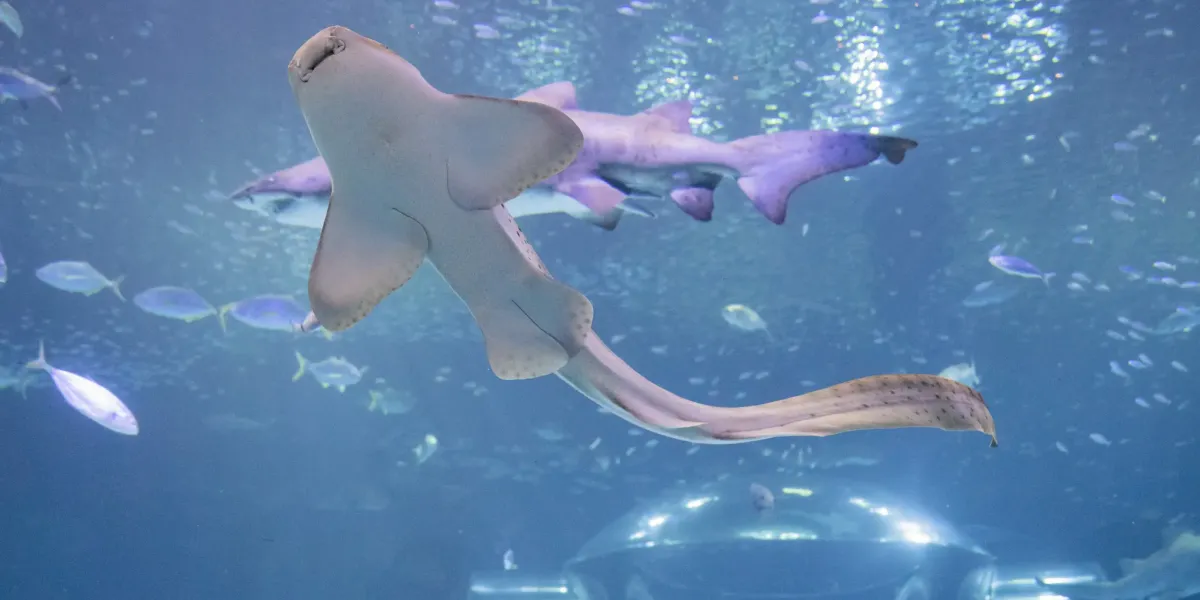
1. Oviparous: although less common, some shark species lay eggs. These eggs are enclosed in a tough capsule that protects the embryo as it develops. Well-known examples of oviparous sharks include the bamboo shark, the zebra shark and the horn shark, whose egg cases have a distinctive elongated or spiral shape respectively.
2. Viviparous: viviparous sharks give birth to fully developed young, similar to mammals. In this case, the embryo receives nutrients directly from the mother through a structure comparable to a placenta. The bull shark and the grey shark are good examples of this reproductive strategy.
3. Ovoviviparous: a mixed method between oviparous and viviparous reproduction. In ovoviviparous sharks, the eggs remain inside the mother’s uterus until hatching, meaning the young are born alive. The embryos feed on the egg’s yolk reserves rather than receiving nutrients directly from the mother. Once the eggs hatch inside the mother, the young are ready to be released into the ocean; the sand tiger shark is an example of this.
How can you tell a male shark from a female?
Distinguishing between male and female sharks is relatively straightforward if you know what to look for. The primary difference lies in the presence of claspers, which are found exclusively in males.
These two tubular structures extend from the pelvic fins and are located on the underside of the shark’s body, just below the tail. They are used to transfer sperm to the female during mating.
Females, by contrast, lack claspers. Instead, only the pelvic fins are visible near the cloaca, the opening through which eggs pass or live young are born.
In many live-bearing species, females are typically larger than males. This size difference provides sufficient internal space to support the uterus during gestation, allowing the developing young to grow until they are born as miniature versions of their parents.
The shark reproductive cycle
Shark reproduction is far from rapid. Many species take several years to reach sexual maturity. Furthermore, after mating, the gestation period — the time during which the female carries her developing young — may last from nine months to more than two years, depending on the species.
This extended gestation period is one of the reasons sharks are particularly vulnerable to threats such as overfishing: they cannot reproduce as quickly as many other fish species.
Once born, shark pups are entirely independent. They receive no parental care whatsoever. From the very first moment, they must swim and hunt on their own, facing an ocean full of challenges. Nevertheless, they are born fully equipped to survive, guided by instincts developed while still in their mother’s womb.
Shark reproduction: a journey into the wild
Shark reproduction is a remarkable process that highlights just how perfectly adapted these animals are to life in the ocean. Through internal fertilisation and a diversity of reproductive strategies — oviparous, ovoviviparous and viviparous — sharks maximise the chances of their young entering the world safely.
Although their reproductive cycle is slow, their offspring are born ready to confront the harsh realities of the marine environment from the outset.
So the next time you observe these extraordinary creatures in the Deep Sea zone, remember that their lives begin in a way just as impressive as the sight of them gliding through the ocean.
Sharks are far more than apex predators — they are striking examples of adaptation and evolutionary success.